

The Accountability Factor:
who is there when your willpower runs out?


I have a proposition.
The reason you aren’t completely winning with money is because you’re the only one who knows about it.
As of the writing of this post, two of the most compelling money-related conversations I’ve had during these early Substack days of mine have been this:
The money system you need is silent.
It runs in the background of your life. It’s consistent. It’s boring. Most of the work is being done for you. It keeps you in control in the present. And it compounds to pay you in the future. Your internal operating system should be this way. Quiet.
The accountability factor needs to be louder.
For some reason it seems that personal finance has been labeled as a solo sport. That it is supposed to be accomplished in the isolation of our homes without the input, or spurring on of anyone else. This is not true. The realities of life make speaking up a key component in the process of perseverance.
Did you catch that?
System = quiet.
Accountability = loud
(Level-headed and conversational, of course. Not loud in the sense we usually think. Loud relative to silence. Louder than quiet. I think you get it. 😊)
Requirements and willpower
As simple as one can attempt to make the path of money management, it asks plenty from you to make your way through. You do have to build, organize, process, automate, and then stay in touch.
Then there’s that little thing called life. Emergencies. Failures. Surprises.
These elements make staying the course quite the challenge.
Even the smoothest, most silent systems and the strongest, most simple habits can encounter a few bad days in a row.
Willpower, which is a depleting resource, can run out.
Maybe that’s you. You could have started, made great progress, and then got derailed. Or maybe you‘re having trouble getting started altogether.
Either way, this is what I believe we’re missing that’s keeping us from real financial progress.
Create a Cadence of Accountability
In the book Deep Work, author Cal Newport references another framework which he outlines called, The 4 Disciplines of Execution. While the original work is geared toward business, Newport translates them well to an individual level. While numbers one through three are useful and certainly applicable to our personal finances, I’m going to intentionally omit those for this conversation and skip straight to number four.
Discipline #4: Create a Cadence of Accountability
Put in place “a rhythm of regular and frequent meetings that owns an important goal.” During those meetings, the person must confront their scorecard (did you do what you said you were going to last time, however that is measured), commit to specific actions to help improve the score before the next meeting, and describe what happened with the commitments they made at the last meeting.
This review can be condensed to only a few minutes, but it must be regular for its effects to be felt. The authors argue that it’s this discipline where “execution really happens.”
The community your money is missing
We were created to need relationships.
We need community. And communities need us.
I’m referring to real human relationships. With people that you like. That you call friends. That you trust. Who have your best interest in mind. And you the same for them.
We need these types of people for the parts of life we already enjoy with them.
But what if we started to believe we need it for some of the things that we typically never talk about—like our own money?
For accountability.
This is what I am proposing.
Your financial progress is on the other side of letting someone else into your process with you.
A quick illustration
Exercising has consistently been a roller coaster of a journey for me. Fortunately for you, we won’t get into that here. But one thing I do know is that, the best seasons I’ve had exercising in my life have been when I was going with someone else.
Why? Because they were relying on me to show up. We were in it together. They didn’t lift the weights for me, but their presence and encouragement ensured that I got stronger. Their expectation of me to be there enabled me to follow through.
Accountability is the discipline where execution really happens.
The process—and where accountability fits in
If you’re a veteran member of The Club, you know that we have a specific process. If you’re new around here (Welcome 🤝), take a look at them.
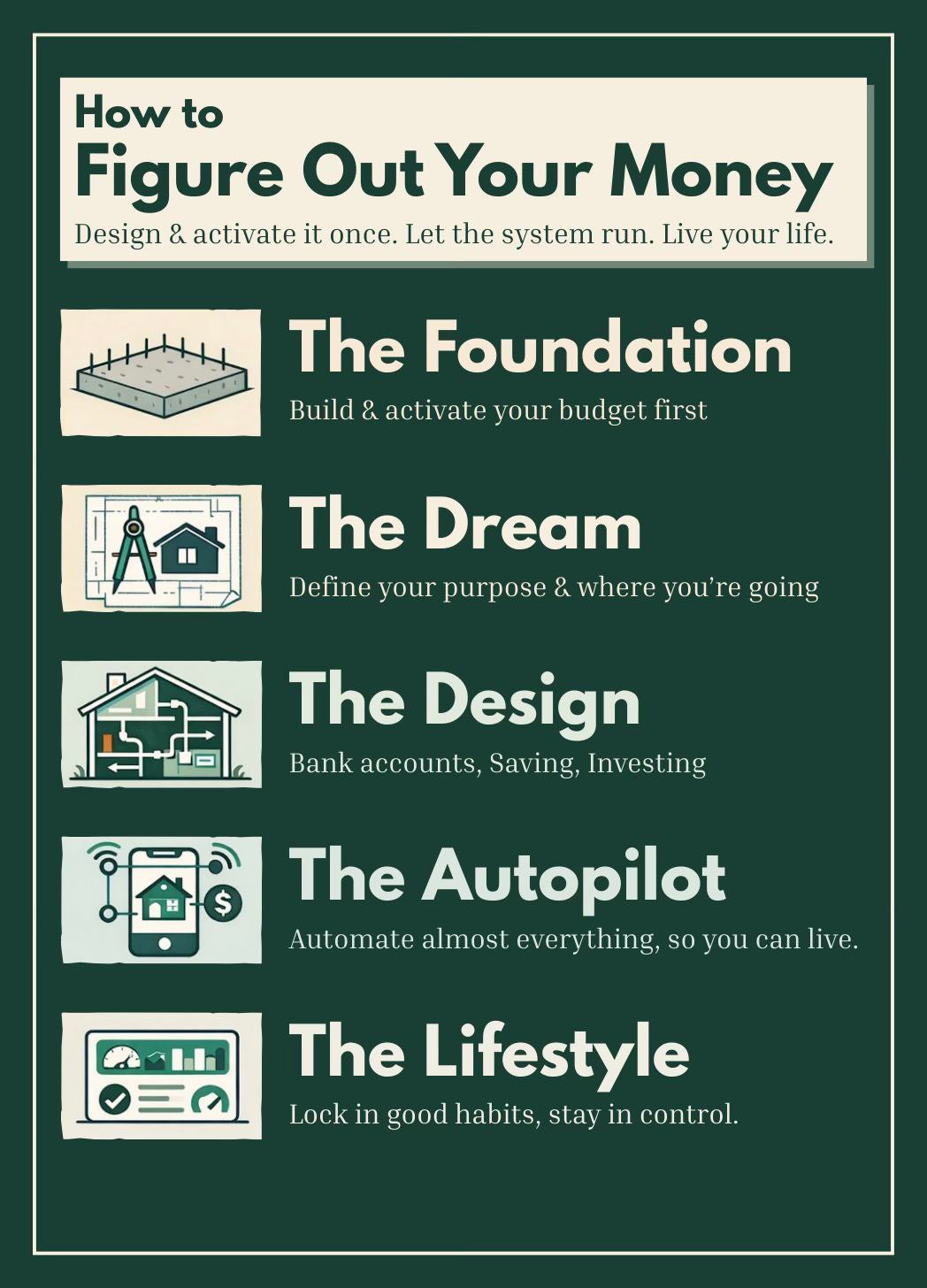
Accountability isn’t a step in the process. It’s what blankets the entire thing. When “✅ start - build my budget” is on my checklist and someone is holding me to it, it means more. The same applies to coming up with my retirement number, setting up my Roth 401k and Brokerage auto-investments, and checking my budget daily.
Let someone else in on your process and I know you’ll make it through.
Why The Wayfinder Money Club exists
I created this Substack for a few reasons, but here’s what is paramount:
Building quiet confidence - guidance to build effective systems that allow us to focus more on life than on finances.
Collaborative community - space where talking about and figuring out our money is normal. We have to begin inserting this into our financial equations.
It’s been said, but life gets messy. When it does, these are the things that will sustain you:
System
Habit
Accountability
When you have all three, the mess can’t take you out.
What collaborative community actually looks like
Here are two ways to ensure sustainable execution by letting someone else into the process for accountability sake. I’d encourage you to implement a version of both.
Coaching
Odds are, most of you haven’t ever considered a financial coach. Most don’t. I know I can’t speak without biased, but I truly believe everyone can use at least a season of coaching. Think about it. Pros have coaching. Having someone guide you through the process of activating your money system will set you up for long-term success.
You have access to two forms of coaching right here:
This Substack
This platform has been designed to make coaching more accessible than ever. Coaching can cost you a lot. And to some extent it should. Investment in something proves to yourself you value it. Here, however, the goal is to provide tons of value that’s more easily accessible, however you need it.
How-to use the club as your coach:
Use the content and resources to work through building your money system.
☑️ Start Here to get going.
☑️ Follow the posts in order. Upgrade to paid to access the attached resources.
☑️ Pick up a Guide for everything in one place.
☑️ Download one of the user-friendly tools to get organized.
☑️ Ask questions in the chat or by reaching out to me directly.
One-on-one Coaching
I won’t spend much time here, but if you do want a personal guide through the whole process I’ll work with you for a year. Send me a message or check out more info at the bottom of the Guides page.
Partnership
This is also most likely a new concept to you because, again, we largely don’t talk about our money with anyone. What if you used a friendship to be productive with your finances? Or another close relationship you already have in your life. Ask them to meet regularly. Complete the Cadence of Accountability meeting flow. Teach them what you’re doing and offer to return the favor.
Use this agenda:
☑️ What did you say you were going to do last week?
☑️ Did you do it? Why or why not?
☑️ What will you do to improve for next week?
Keep it short and sweet. It will get repetitive. But I bet you will feel a healthy level of pressure to do what you say you are going to do.
Here are some options for who you can parter with:
☑️ Your spouse if you have one
☑️ A close friend you trust that has your best interest in mind
☑️ A family member that meets the same criteria above
☑️ A mentor
☑️ A co-worker
Add this to both of your weekly calendars. Invite each other. Meet for coffee. Make it a quick phone call. Voice memo back and forth if you have to. Just make sure it gets done. Every time.
Here’s what I’m asking you to do
I really do want you to experience transformation through this space. We call it Wayfinder for a simple reason…we’re all just trying to find a way. From confused to clear. From stuck to in motion. From absent to fully aware. From just starting out to experiencing real progress.
Let’s find a way together.
Here’s what I’d love for you to do:
Engage in The Club - Use the resources, learn from each other, get the coaching you need.
Lock-in your partnership - Really do this. Send the text. Make the ask. And tell me how it’s going. I’d love to hear!

It’s time to give your habits accountability.
Remember where we started
Silence is one of the most expensive money habits we have. We don’t talk about money with friends. We don’t compare notes. We don’t ask questions. So everyone assumes everyone else has it figured out. This we know, isn’t true.
The silence creates anxiety, shame, and isolation—often for people in the exact same situation. Money problems don’t grow because people are bad with numbers. They grow because people feel alone.
Progress will accelerate when money becomes a shared conversation instead of a private burden. The moment you talk about money, it loses power over you. Have a real money conversation with someone.
Make accountability a real factor in your journey toward financial freedom.
Would you share this with someone? If you made it this far, it’s clear we’re here for collaborative community as much as system development. So send it to someone you know who can use it too. Much appreciated!
AMAZING post, Matt!! community while trying to invest and build wealth is super important! your network also equals your net worth!!